
Interview
On Collaboration and Writing About Love—with Grant Faulkner
Valerie Fox: Something Out There In the Distance opens with a lovely lyricism, letting readers know the book will be giving us a portrait of Dawn. We’re also given to know that there will be a mysterious, indefinite quality to her (and the story). The opening image and title emphasize that. As a collaborative effort with Gail Butensky, was this mystery planned or did it emerge from the writing?
Grant Faulkner: No, it wasn’t planned at all. In fact, quite the opposite. Gail [Butensky} gave me 30 or 40 of her photos to choose from. Initially, I planned to write an individual 100-word story to each photo, but as I started writing stories, I began to see a series of linked short-shorts emerge and form itself into what I call a “flash novel”—a short story with a novelistic feel (in part because of the images).
What was wonderful, process-wise, was how each photo was like drawing a different prompt from a deck of cards. I loved just choosing a photo, writing a story, and building a narrative relatively randomly and intuitively. The two main characters are these doomed lovers, Dawn and Jonny, and I simply followed their yearnings, their pains, their wonder. I mainly write to a character’s yearning instead of their conflict. I find our yearnings more defining of who we are as people.
VF: Dawn’s love of word play stands out as does her overall love of play (her rhyming banter, for example). How is this sense of play important to the story?
GF: Dawn likes to mix things up. She likes to say things and see what sort of reaction they get. Language is one of her favorite tools. She knows she’s good with words. It’s not something she’d say about herself, she is just naturally inventive with words. She loves when everything is at the precipice, tilting, maybe ready to fall. She’s constantly creating and recreating the world around her.
I think of her as introducing Jonny to word play, to the art of the verbal joust. Dawn understands how words can be transcendent, how they can open portals, yet end up as inadequate, not quite enough, just as life itself is not quite enough, even when it seems like it’s too much.
VF: Early on we learn how Dawn both “hated” and “loved” golf courses–and there are often other opposites and qualifications to her and Jonny’s views and actions. For instance, there’s the poem-like dialogue (opposing description of palm trees) as well as the idea that one story is “right” and one is “wrong.” How did you use language overall, or these kinds of loaded terms like “right” and “wrong” to shape the characters, sharpen them, give them angles?
GF: That’s so interesting you noticed all of that, because I actually hadn’t thought of that while writing the story, but you’re right, and I appreciate that reading. I suppose every love holds a tension, a joust of some sort. Neither character holds onto any “right” or “wrong,” per se, but they have playful verbal teases, private flirtations that create a frisson between them.
While love obviously provides comfort, it also needs discomfort, unpredictability, disruption, questioning. Dawn and Jonny know this intuitively, but Dawn more so. Dawn will forever be unsatisfied in her way, no matter how much Jonny dotes on her. Part of Dawn’s appeal is her impossibility, I think.
VF: Could you share with NFFR readers one of more of your favorite images by Gail and how it works (or they work) in the book? The colors and lines (and everything) are just stunning.
GF: I love the photo of the palm trees and how Dawn and Jonny’s dialogue makes the palm trees strange characters presiding over the desert.
I love the photo of the vibrant rose, how something of such beauty and moisture can end as a desiccated object on a dashboard.
I love the photo of the oil well because it too becomes a character: a menacing toiling figure extracting things from the earth. It’s both stately and alien and dangerous at the same time.
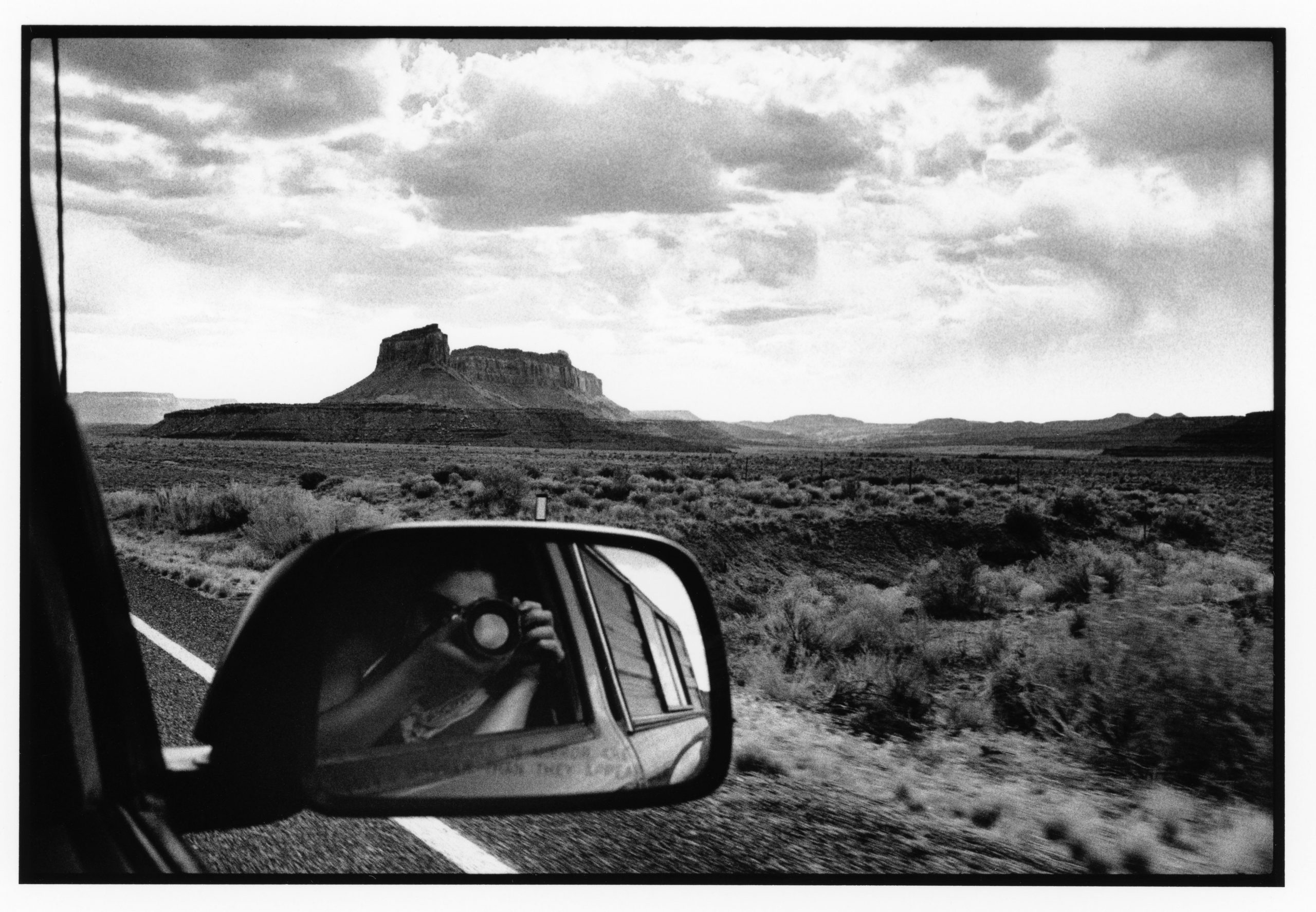
But then I also love the photo of the camera in the rear-view mirror that captures the glee of flight, the way the world can be two or three things at once, the way that all is fleeting and wondrous.
VF: Could you talk about time as a character in this story?
GF: Time is running out. Yet it’s never ending. Somehow both at the same time. When you’re on a road trip, a true road trip, it somehow seems that you exist outside of the usual boundaries of life. You can eat junk food with impunity. You charge things as if they’re free. You disappear into a strange anonymity where it’s just you and the highway and people at convenience stores.
Jonny and Dawn start to forget that their lives exist in time. That’s what they’re seeking without knowing it: forgetfulness. It’s not a bad place to reside if you’re feeling a lot of pain.
VF: Jonny’s voice conveys his love and his concern for helping Dawn through her illness. And you do a great job of getting the readers to share his sense of loss and to understand his choices. How do you pull this off and avoid cliche?
GF: I have no idea. Jonny is my perfect character in some ways. He has a great intuitive sense of life. He knows things he can’t put into words. He’s like a prophet on a pilgrimage, except no one is ever going to listen to what he discovers.
Maybe this is why he’s not a cliché, because he’s more a part of the wind than part of real life. He’s poetic, dreamy, but without grandiosity. In fact, he prefers to be in service to others, to take care of them. He’s lost, confused, but he’s always been lost and confused, and he knows little else.
He’s not a rebel, yet he doesn’t necessarily fit in. He’s not a lover, yet he is. I think of him living in the present. That’s his great talent, his presence in the moment.
VF: Could you share with NFFR readers what you are writing these days? What are your current favorite works in progress?
GF: I’m a weird writer these days. I’m working on a memoir, Heart Failure: The Story of a Maniac. Six years ago I was diagnosed with a slew of heart problems. I realized that I’ve experienced a major medical problem every decade of my life, and while they all seem separate, they’re actually connected, the same problem: I’m a maniac. I’ve lived a maniac’s life. And I’ve put my body through hell as a result. So my memoir probes that.
At the same time I’m working on an Almanack with an amazing writer, June Gervais. Man, I don’t know how to explain this except it’s super fun. Almanacks are both practical and woo woo and corny and funny and out-dated and just so wonderful. June and I are redefining the Almanack, you might say. Watch out.
There’s also an epistolary novel, The Letters. A novel about love in all of its variations. Inspired by Roland Barthes’ A Lover’s Discourse. Forbidden love. Which is the best kind of love. It will be out in 2027.
VF: Thank you, Grant, for sharing your insights with our readers!
Grant Faulkner is the cofounder of 100 Word Story, the cofounder of the Flash Fiction Institute, and the cofounder of Memoir Nation (and the co-host of the Memoir Nation podcast). He is the author of several books, including The Art of Brevity, Fissures, and All the Comfort Sin Can Provide. He just published something out there in the distance, a “flash novel” of linked short-short stories written to Gail Butensky’s photographs. He is also an executive producer on America’s Next Great Author.
Gail Butensky has been taking photographs since the 80’s. Her work can be seen in several magazines, books, fanzines and record albums. After years of films, darkrooms, gritty nightlife and bands, she now mostly shoots with her phone in the california sun.