
Interview
Ed. Note: Unless otherwise stated, the stories mentioned in questions are contained in Pardon Me For Moonwalking.
Valerie Fox: Thank you for taking part in this interview for NFFR, Patricia. Do you have different approaches to long and short forms? What attracts you to both? Do you know from the start whether a writing will be a short flash or turn into a short story or novella?
Patricia Q. Bidar: I start with a phrase or a situation, or a feeling I get from a film or another work of art. Then I see where it leads. I go with the expansiveness or compression the narrative requires. I began writing in the early 1990s, with very long short stories. I’m still attracted to the rich worldbuilding of longer works. The digressions. I started writing flash in 2017. What an astounding, challenging form! Lately, micros are not coming easily to me. When I really feel the urge to write something that distilled, I’ll prime the pump with a class, like Francine Witte’s great popup groups, or Sarah Freligh’s fine classes.
VF: Many of your scenes in your recent books portray groups in a very intense way: Daphne, Mr. Clark, and Matteo processing their own struggles on the day the Rodney King verdict came down in “Loosies”; the road trippers in “Pardon Me for Moonwalking”; the three women (so different from each other) working together at the law offices in your novella, Wild Plums. How do you arrange characters together, or portray their words and bodies in a space?
PQB: In my life, I am most comfortable in 1:1 interaction. But good literary fiction is not about being comfortable, is it? Workplaces, family road trips. My goodness: PARTIES. Trap a trio in a room or a car or an awful meeting and there are bound to be tensions. I want to write more love triangles like “Loosies” and “Pardon Me for Moonwalking.” Lily King’s Euphoria is a marvelous modern example, as well as The Great Gatsby and Cyrano de Bergerac. In our flash world, Kim Magowan has given us some memorable trios.
VF: What are some of your favorite parts of writing—the starting, the editing, the research etc.?
PQB: What satisfacton there is in spitting out whole a rough flash draft. But I am in love with research and editing. The rabbit holes that yield weird, so-real detail. Or the thrill I get from making something richer through compression. With some stories, I simply keep on updating them unto infinity. It’s a real winning move with editors—kidding! A story being finished forever is an odd notion to me.
VF: I appreciate your strong sense of place in your writing, for example, in the young man’s childhood room in “It Is the Summer of Space Lab” or the club and city in “Rat Girl.” What places and times have influenced you as an artist?
PQB: If any aspect of my writing is biographical, it is setting! I have returned again and again to San Pedro, the part of Los Angeles where I grew up. I spent my twenties and part of my thirties in San Francisco. It was a rich and crazy and devastating and fertile time in that place and in my life. A setting one knows and is able to fully return to in memory truly is the gift that keeps on giving.
VF: In “Stain,” Alice, an intriguing and wistful character, is at a “transit point.” I’m left wondering where she’ll go next. Do you ever feel like revisiting Alice (or her town) or others who inhabit your short pieces?
PQB: Transit points can provide wonderfully taut occasions for flash and micros. “Stain” is very much a standalone piece. Between about 2017 and 2020, I began reading and writing flash fiction. I took online classes with Meg Pokrass, and read many, many flash works in online journals and anthologies. Meg’s assignment here was to write a flash piece in the style of a writer you admire. Can you guess who mine was? (The MC’s name is a hint.)
VF: Do you have any specific advice for those just starting to write fiction seriously?
PQB: My advice is to read, read, read. Give yourself time to reflect in solitude. Eavesdrop. Soak life in. Volunteer with a journal you vibe with. Some of the flash writers I’m excited by are Sabrina Hicks, Ani King, Avitus Carle, Claire Guo, Travis Flatt, Emily Rinkema, Len Kuntz, and Jaime Gill. Early influences included Toni Morrison, Tillie Olsen, Maya Angelou, Edna O’Brien, and my thesis advisor, Elizabeth Tallent. In more recent years, Joy Williams, Lucia Berlin, Annie Ernaux, Claire Keegan, Nick Flynn, Lauren Goff, Lori Ostlund, and Yiyun Li have inspired me tremendously. I just read an absolutely intoxicating short novel by Stacey Levine, called, “Mice, 1961.” I could go on for pages about films and music and painters. Just let yourself be inspired. Don’t be afraid of your own weirdness.
VF: Thanks for all those specific tips. I also appreciate that idea of “updating” your stories “unto infinity” and the joy you take in research and other art forms. What particular work of art or music (through research or otherwise) has helped you write a story you love? Could you write about how that work or your experience of that work influenced a story or your process for that story?
PQB: The story that leaps to mind is Before The Election, published in 2021 in Milk Candy Review. I was taking a class with Kathy Fish, and she’d provided certain words as part of a prompt. I remember the white boots. A performance. Maybe a religious setting?
It was a swirly, scary time, during our current president’s first term and before a COVID vaccine was available. I’d recently visited Mission San Juan Bautista, where a pivotal scene in Hitchcock’s Vertigo was filmed. The place is memorable. You do see chickens in the road when you turn toward the town’s main street. I always enjoyed Doña Esther’s, which I associated with the color red. Only the restaurant was closed. Everything was. No one was out. As I developed the story, I watched and then delved online into Vertigo; and into Mission San Juan Bautista, and Doña Esther’s. The Amah Mutsun and the San Andreas Fault. It was a deeply satisfying experience over months.
For fun, see what Lori Sambrol Brody did with Kathy’s prompt here!
VF: Having published your two recent books, do you find it difficult or energizing to move forward with new works? We’d love to hear about some new or recent projects.
PQB: I found it difficult to start writing again once I was preparing for Pardon Me for Moonwalking to come out. I was swept up in articles in Poets & Writers, The Writer’s Chronicle, podcasts, interviews, and a wonderful online launch as part of Smokelong Quarterly’s book club. All this is to say I lost a lot of writing momentum. I’m very slowly starting to write some words that become narratives, and it feels great. One is about my mother, another is about my first and only fist fight. A spooky sleepover, and an unsettling trip to San Francisco when I was in high school. I’m expanding into guest editing some cool “roundups,” and judging contests like the one for NFFR—as I plug away on finding a home for my second collection of flash, Are You Experienced?
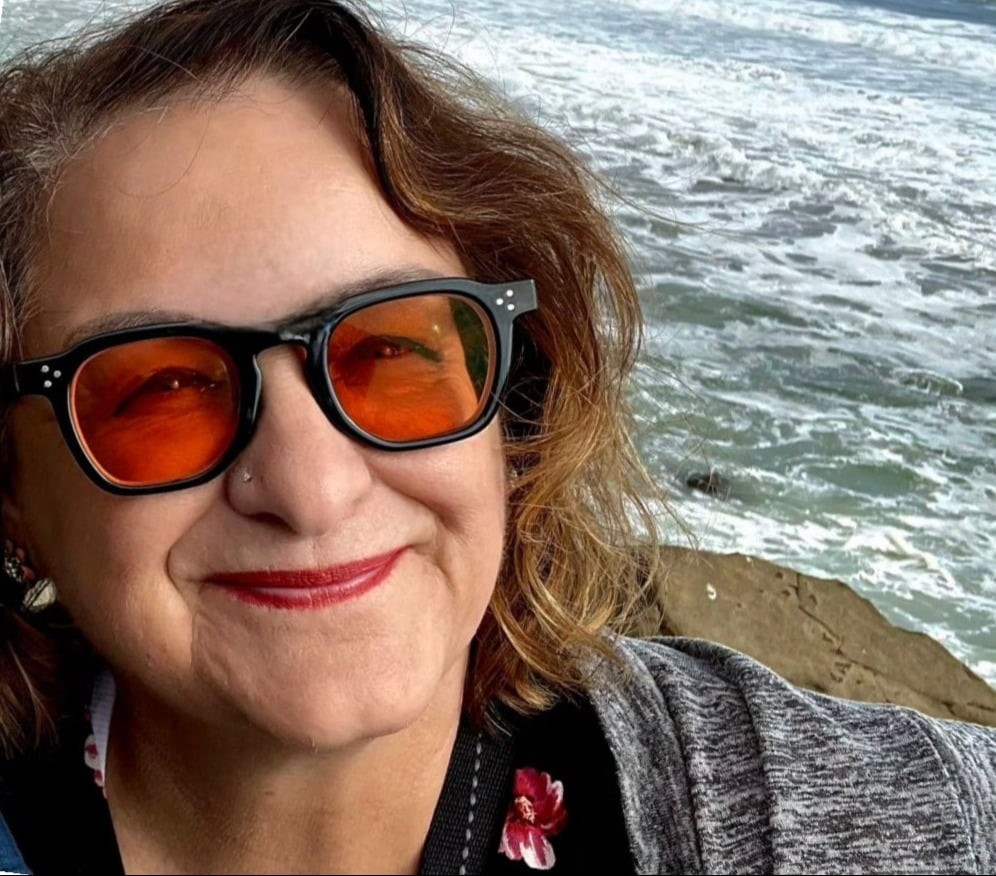
Los Angeles native Patricia Q. Bidar is the author of Pardon Me for Moonwalking (2025) and Wild Plums (2024). Her work has appeared in Waxwing, Painted Bride Quarterly, The Pinch, Wigleaf, and Smokelong Quarterly, and included in the Flash Fiction America (W.W. Norton), Best Small Fictions, and Best Microfiction anthologies. She lives with her family outside of Oakland CA. Visit patriciaqbidar.com.